Friday, May 29, 2020
Thursday, May 21, 2020
"Unlike Anything We Have Seen In History": The Coronacrisis Will Wipe Out Over 4 Years Of GDP Growth
Now that banks have had a chance to evaluate the collapse in the economy in the post-covid world, a new round of GDP forecast revisions is coming, and it's a doozy, with Bank of America spearheading the latest effort by slashing its Q2 GDP forecast from -30% to -40%.
Not without a trace of irony, BofA's chief economist Michelle Meyer writes that "words cannot describe" the loss in economic output, which is "unlike anything we have seen in modern history. Back in early April when we introduced our forecasts, we penciled in a stunning 10% cumulative drop in output from the peak with the pain concentrated in 2Q with a 30% qoq saar decline."
But it seems that it was not extreme enough, and according to data released since then, the drop will be more severe, with BofA now looking for a 40% Q/Q saar decline in 2Q, translating to a cumulative loss of 13%. To put this into perspective, in the Great Recession of '08-09, the economy declined 4%. This recession would clearly be much deeper.
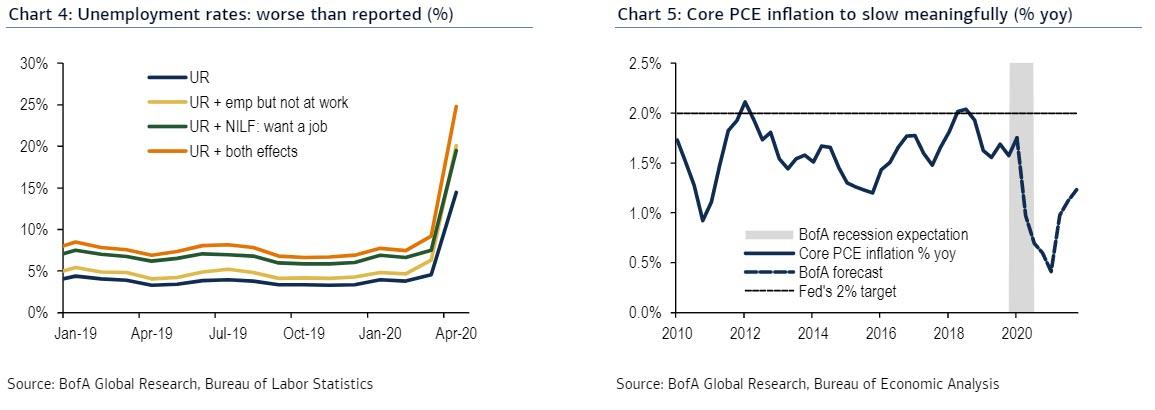
BofA now believes that the unemployment rate will reach a peak of 19% at the end of 2Q, while broader measures of unemployment suggest that the rates are already in excess of 20%. In the initial stages of the recovery, the unemployment rate will fall sharply upon reopening but will likely get stuck close to 10% for some time. This, as Meyer warns, is a recipe for disinflation and could prove catastrophic for banks that haven't provisioned enough for loan losses. The bank forecasts core PCE inflation will reach 0.6% yoy by year-end, although the bank still believes that the US will avoid outright deflation in underlying inflation and that the focus will be on measures of expectations.
It looks at four hypothetical types of recoveries: a "V" (upside) a "U" (close to the current), an "L" (downside) or a "W" (downside). In all cases, it assumes that output falls by 40% annualized in 2Q and trend growth of 1.8%.
- In the V-shaped recovery example, GDP gets back to potential in four quarters (by the end of 1H 2021) and then remains on trend. Therefore the recovery is twice as long as the downturn and lost output is not recovered. Still, this scenario would require nearly 18% growth over the next year, which we think is unrealistic.
- In the U-shaped recovery scenario, GDP takes longer to return to potential and more output is permanently lost. GDP gets back to trend at the end of 2022. Even this requires an average of 8% growth over the next ten quarters. Notice that BofA's baseline forecast is closest to a "U" or "swoosh" scenario.
- An L-shaped recovery is the slowest, with the greatest permanent loss in output. It takes until the end of 2023 for GDP to return to its pre-COVID level. Growth averages 4% in that period.
- What about a "W"? The most likely scenario for a W-shaped ("double dip") recovery is a second major virus outbreak in the fall/winter, which causes another round of shutdowns. There are many possibilities depending on the severity and duration of the shutdowns.


Subscribe to:
Posts (Atom)